


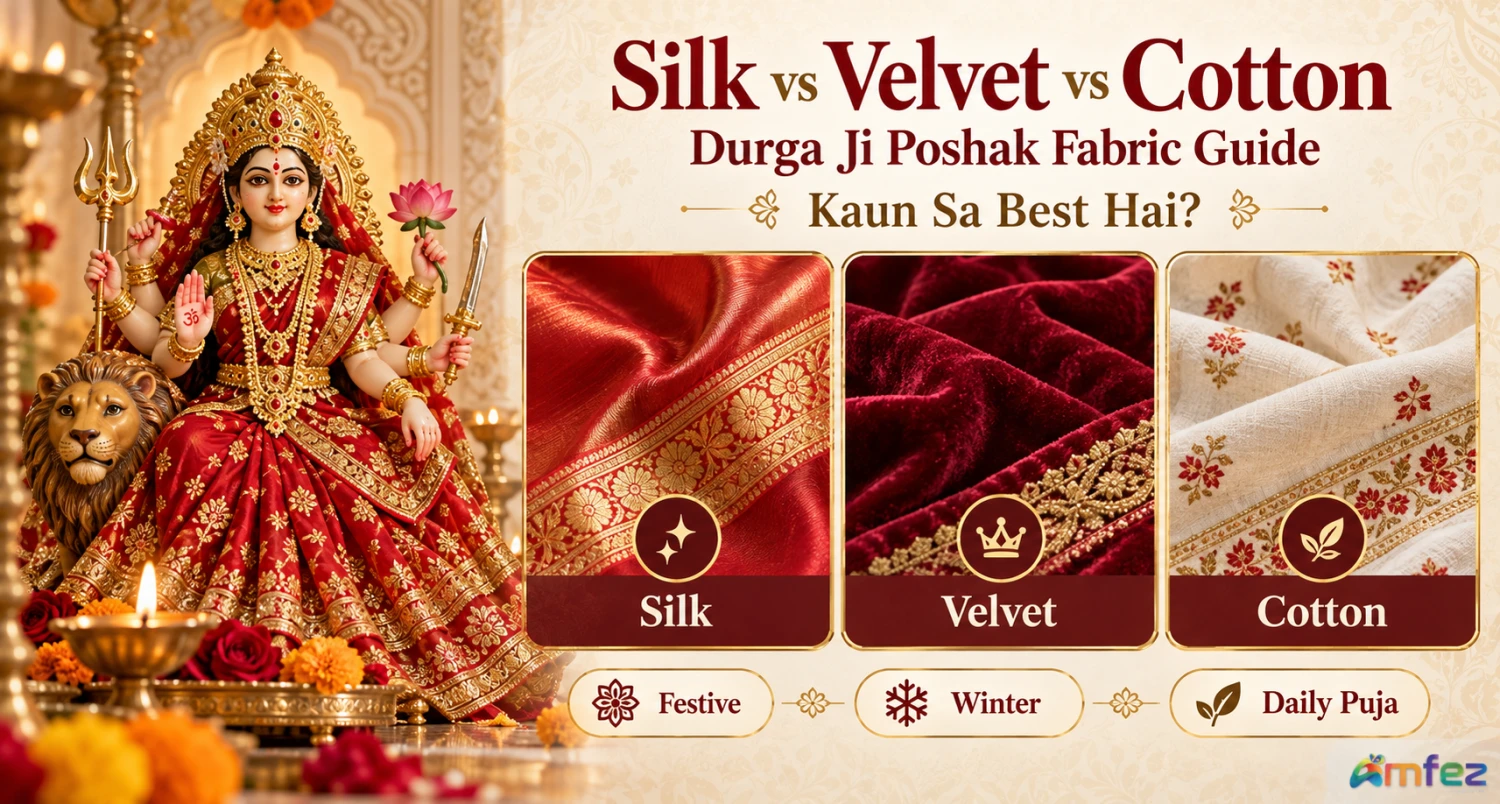
The colour of a poshak is decided by the day. The fabric is decided by the season, the deity's form, and the feeling you want the puja to have.
A red velvet poshak on Katyayani's day and a red cotton poshak on the same day are not the same offering. The velvet has weight. The silk has light. The cotton has simplicity. Each fabric speaks to Mata in a different register — and for a devotee who is paying attention, the fabric is as intentional as the colour.
This guide covers the three most common Durga Ji poshak fabrics — silk, velvet, and cotton — for every season and every occasion.
Which Fabric is Best for Durga Ji Poshak — Silk, Velvet, or Cotton?
The best fabric depends on the occasion and the season. Silk is the traditional choice for festivals and Navratri — its lustre makes the poshak radiate. Velvet is best for winter months and the most auspicious puja days — its weight and richness feel appropriate for major offerings. Cotton is best for daily puja and summer months — light, washable, and devotionally pure in its simplicity.
| Silk | Velvet | Cotton | |
|---|---|---|---|
| Look | Lustrous, reflective | Deep, rich, matte | Clean, simple, modest |
| Weight | Light–medium | Heavy | Light |
| Best season | All seasons | Oct–Mar (winter) | Apr–Sep (summer) |
| Best for | Navratri, festivals | Ashtami, Navami, special puja | Daily puja, simple occasions |
| Embroidery | Gold zari, stone work | Heavy gold zari, sequin | Light print, minimal embroidery |
| Washable? | Dry clean preferred | Dry clean only | Hand wash — easy |
| Price range | ₹249–₹799 | ₹299–₹999 | ₹199–₹449 |
Silk Poshak for Durga Ji — When and Why?
Silk has been the fabric of temple worship in India for thousands of years. It catches light differently at different times of day — the same yellow silk poshak looks golden in morning sunlight and warm amber in the light of a diya. This quality makes silk the natural choice for Navratri, when the puja happens at multiple times of day.
Silk poshaks with gold zari (metallic thread) embroidery are the most traditional. The zari catches the diya's flame and creates a living, moving quality in the fabric that cotton and velvet cannot match. For the 9 Navratri forms of Durga, silk is appropriate for Shailputri (Day 1), Skandamata (Day 5), and Kaalratri (Day 7) — forms associated with light, sky, and radiance.
Chanderi silk and art silk (polyester silk) are more affordable alternatives that have a similar lustre. Pure silk is rare in poshaks under ₹500 — at that price point, art silk gives the best appearance for the cost.
Velvet Poshak for Durga Ji — When and Why?
Velvet is the heaviest and richest poshak fabric. It absorbs light rather than reflecting it — creating a depth of colour that silk cannot match. A deep red velvet poshak on Katyayani's day looks like the most serious offering possible. Velvet is appropriate for the most important puja days: Ashtami, Navami, and any day you are making a specific vow or request to Mata.
The practical consideration: velvet is warm. In India's climate, velvet poshaks are most comfortable in the October–March period. A velvet poshak on a summer day, in a warm mandir, is not wrong — it is just heavier than necessary.
Velvet holds embroidery — particularly heavy gold zari and sequin work — better than any other fabric. The weight of the velvet anchors the embroidery so it sits flat and even. This is why the most elaborate poshaks — the ones with full zari coverage and stone work — are almost always on velvet.
Cotton Poshak for Durga Ji — Daily Puja and Summer Months
Cotton is the fabric of simple devotion. It has no lustre, no weight, no drama. What it has is purity, breathability, and washability. Many devotees who change Mata's poshak daily choose cotton for the six non-festival months — it is easy to wash, dries quickly, and is comfortable on the murti in warm weather.
Cotton poshaks with block-print borders or simple embroidery are the traditional choice for daily puja. They are not lesser offerings — Mata receives the bhav (intent), not the thread count. Some of the most devoted pujas in India are done with simple cotton poshaks offered in clean, unadorned sincerity.
Browse all three fabrics in our Durga Ji poshak collection — silk, velvet, and cotton in all 9 Navratri colours, ₹199 onwards.
दुर्गा जी की पोशाक के लिए रेशम, मखमल या सूती — कौन सा चुनें?
नवरात्रि और त्योहारों के लिए रेशम (silk) सबसे उचित है — इसकी चमक दीये की रोशनी में जीवंत हो उठती है। सबसे महत्वपूर्ण दिनों (अष्टमी, नवमी) और सर्दियों के लिए मखमल (velvet) सबसे उपयुक्त है — गहरा रंग, भारी ज़री का काम। रोज़ की पूजा और गर्मियों के लिए सूती (cotton) सबसे सरल और शुद्ध विकल्प है। Amfez पर तीनों fabric में पोशाक ₹199 से उपलब्ध हैं।
Frequently Asked Questions — Durga Ji Poshak Fabric
Q: Is polyester silk poshak as good as pure silk for Durga Ji?
A: For puja purposes, the bhav (intent) matters more than the thread. Polyester art silk is widely used in temple-grade poshaks across India — it is durable, holds colour well, and has a comparable lustre to pure silk at a fraction of the cost. Pure silk is more prestigious but not more devotionally valid.
Q: How to wash and store Durga Ji poshak?
A: Cotton poshaks can be hand-washed with mild soap and air-dried. Silk poshaks should be dry-cleaned or very gently hand-washed in cold water without wringing. Velvet poshaks should be dry-cleaned only — water and wringing damage the pile permanently. Store all poshaks folded in a clean, dry cloth (not plastic bags) to prevent moisture and moth damage.
Q: Can I offer a cotton poshak on Ashtami?
A: Yes. There is no rule that Ashtami requires a specific fabric — only the colour (pink for Mahagauri) is the tradition. If cotton is what you have and the bhav is sincere, it is a complete offering. The velvet preference for Ashtami is a cultural tradition, not a religious requirement.