


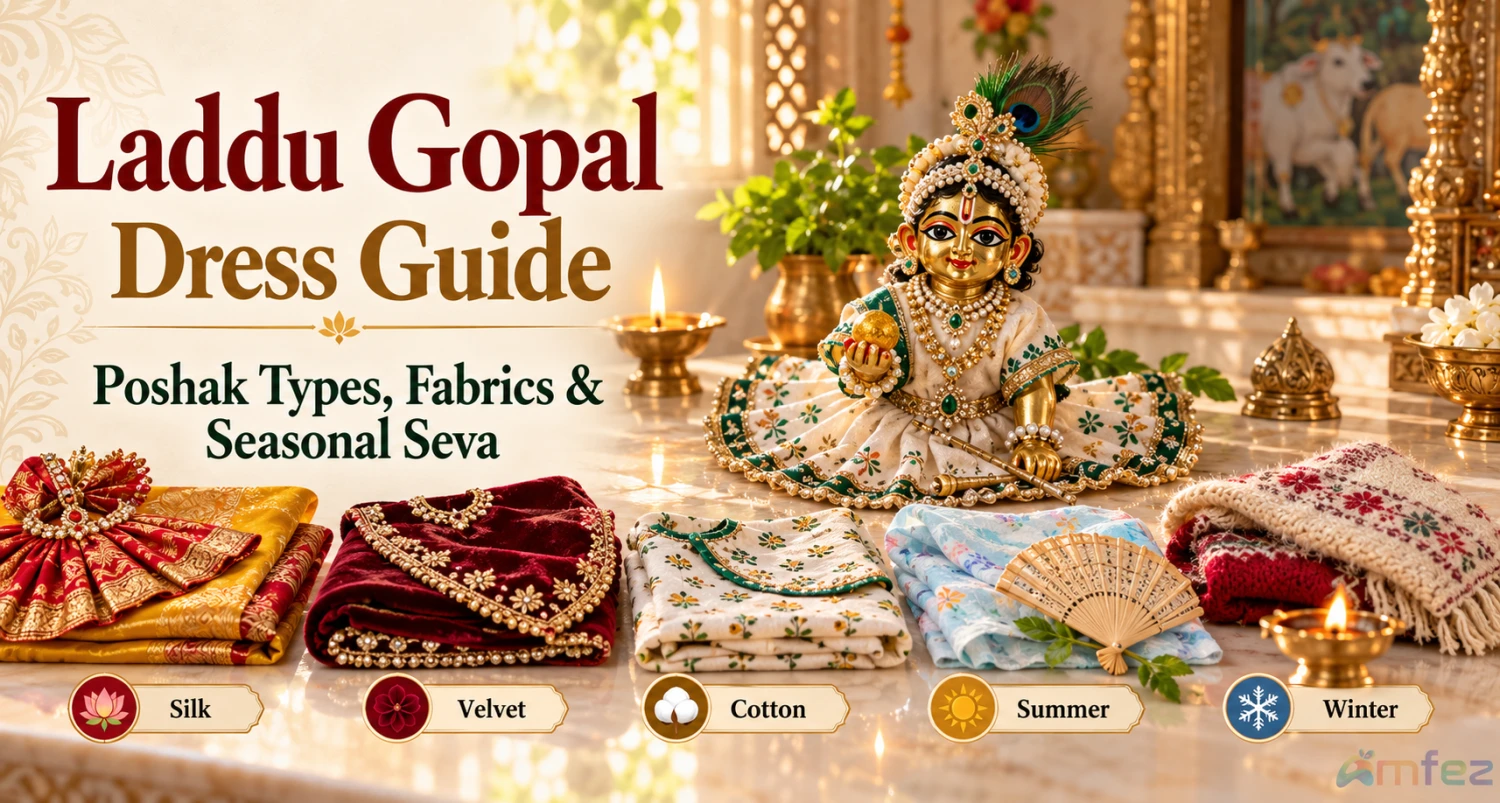
Every devotee who has Laddu Gopal Ji at home knows the feeling — you see a beautiful poshak, you buy it, and the moment you dress your Thakurji, something feels perfect. That small act of seva, of dressing up your Kanha with a fresh dress, is not just ritual. It is relationship. It is the daily reminder that He is present in your home.
But choosing the right Laddu Gopal dress is not always simple. Cotton or silk? Festive embroidery or simple daily wear? Which fabric for which season? How many poshaks does your Thakurji actually need? These are real questions every devotee faces, and this guide answers all of them — clearly, practically, and from experience.
A Laddu Gopal dress (poshak) is the divine garment worn by your Thakurji murti as part of daily seva. Choose cotton for daily wear and summer, silk or brocade for festivals, and velvet or woollen fabric for winter months. The poshak should fit the murti comfortably — not too tight, not baggy — and be changed on auspicious days like Ekadashi, Purnima, and every festival.
What is a Laddu Gopal Dress — and Why Does It Matter?
A Laddu Gopal dress, called poshak (पोशाक) in Hindi, is the garment made specifically for Bal Gopal or Laddu Gopal murtis kept in home mandirs. Unlike cloth offerings to other deities, dressing Laddu Gopal is a personal act — you are clothing a child deity, your own Kanha, whom you have accepted as a member of your household.
In the Vallabh Sampraday and Pushti Marg traditions, the sevā of Thakurji includes poshak as a core element. Shodashopachara puja — the sixteen forms of worship — includes vastra (clothing) as one of the most important offerings. You are not just decorating an idol. You are dressing your Ishta Dev.
Practically speaking, a well-fitted poshak also protects the murti from dust, keeps it looking reverent, and creates a visual focal point in your mandir that sets the tone for your puja. A fresh poshak on an important day changes the energy of your puja space immediately.
What Are the Different Types of Laddu Gopal Dress?
Most devotees think poshak means one type of dress. In practice, there are four distinct categories, and your Thakurji genuinely benefits from all four.
- Simple, clean, easy to wash
- Cotton or blended fabric
- Light embroidery or plain design
- Changed on Ekadashi, Purnima, or as part of daily shringar routine
- Affordable — ₹49 to ₹199 range
- Silk, brocade, or zari work
- Heavy embroidery, mirror work, stone decoration
- Reserved for Janmashtami, Diwali, Holi, Radha Ashtami
- Should match the festival's traditional colours
- ₹249 to ₹449+ range
- Matched to weather, not festival
- Winter: velvet, woollen, fleece
- Summer: cotton, voile, muslin
- Rainy season: lighter fabrics, brighter colours
- Changed at season transition dates
- Soft night wear poshak — changed before Thakurji is "put to rest" (shayan seva)
- Bridal-style for Radhashtami, Vivah Panchami
- Designer sets with matching pagdi, mala, mukut included
- Birth occasion poshak (for devotee's auspicious family events)
Which Fabric is Best for Laddu Gopal Dress — Cotton, Silk, Velvet or Brocade?
The fabric question is the one devotees ask most often when buying a Laddu Gopal poshak online. Here is a straight answer based on season and use:
| Fabric | Best Season / Use | Feel | Price Range |
|---|---|---|---|
| Cotton | Summer (March–June), daily wear year-round | Soft, breathable, light | ₹49–₹199 |
| Silk / Art Silk | Festivals, puja days — year-round | Shiny, elegant, holds embroidery well | ₹125–₹349 |
| Brocade | Festive — Janmashtami, Diwali, Holi | Heavy, structured, royal look | ₹249–₹449 |
| Velvet | Winter (November–February) | Warm, soft, rich colour depth | ₹199–₹399 |
| Woollen / Flannel | Peak winter (Dec–Jan) | Cosy, protective, thick | ₹149–₹349 |
| Georgette / Net / Organza | Monsoon and spring festivals | Sheer, flowing, elegant | ₹125–₹299 |
Tip from experience: Art silk (also called artificial silk or polyester silk) is not the same as pure silk. It is cheaper and easier to wash, which makes it better for daily wear. Pure silk or brocade is for special poshaks you don't wash every week.
When Should You Change Your Laddu Gopal Poshak — Seasonal Seva Calendar?
Traditional devotees follow a seasonal poshak change tied to the Hindu calendar's six ritu (seasons). Here is a practical calendar based on what families actually do:
| Season (Ritu) | Months | Recommended Poshak | Colour Idea |
|---|---|---|---|
| Vasant (Spring) | Feb–Mar | Light cotton, floral prints | Yellow, light pink, white |
| Grishma (Summer) | Apr–Jun | Thin cotton, muslin | White, light blue, cream |
| Varsha (Monsoon) | Jul–Sep | Silk, georgette | Green, peacock blue, dark yellow |
| Sharad (Autumn) | Oct–Nov | Silk, brocade for Navratri/Diwali | Red, saffron, gold, deep pink |
| Hemant (Early Winter) | Nov–Dec | Velvet, light woollen | Maroon, purple, deep green |
| Shishir (Peak Winter) | Jan–Feb | Heavy velvet, woollen, flannel | Deep red, navy, royal blue, black |
Within each season, change the poshak on Ekadashi (11th day of the lunar fortnight) at minimum. Many devotees also change on Purnima (full moon), Amavasya (new moon), and every Monday or Thursday as their personal niyam.
What Do Poshak Colours Mean for Laddu Gopal Ji?
Colour is not just aesthetic in a poshak. Each colour carries devotional meaning, and many traditional families follow a colour-day practice:
- Yellow (Peetambar): Krishna's most sacred colour — associated with Vishnu and wisdom. Ideal for Ekadashi seva, Thursdays, and Purnima.
- Blue / Dark Blue: Represents the form of Shyamsundar — appropriate for Janmashtami and Krishna Jayanti.
- Red: Festive, auspicious — Diwali, Navratri, marriage-related occasions.
- White / Cream: Purity, simplicity — Sharad Purnima, morning seva, summer daily wear.
- Green: Varsha ritu, Hariyali Teej, Nag Panchami period.
- Saffron / Orange: Devotional energy — used across year for festive poshak.
- Pink / Rose: Radha's colour — Radhashtami, Braj Holi, spring festivals.
There is no strict rule that says you must follow day-wise colours, but many devotees find that following these colour associations deepens their daily connection with seva.
How Many Poshaks Should Your Laddu Gopal Have?
This depends on your seva niyam (personal practice). A practical minimum:
- 3 daily wear poshaks — so you always have one available while another is being washed
- 4–6 seasonal poshaks — at least one per season, ideally two per season for rotation
- 3–5 festive poshaks — Janmashtami, Diwali, Holi, Radhashtami, at least one for big festivals
That comes to roughly 10–14 poshaks as a well-equipped starting collection. Experienced devotees often have 20–30+ over time as they add festival-specific pieces each year.
Explore the full Laddu Gopal poshak collection at Amfez — sizes 0 to 11, fabrics for every season, priced from ₹49 onwards. Many sets come with matching pagdi or mala included.
What Makes a Good Laddu Gopal Dress — Embroidery and Finishing Quality
Two poshaks at the same price can feel completely different in quality. Here is what to check:
- Zari and thread embroidery: Real zari (gold/silver metallic thread) stays bright longer. Machine embroidery is fine for daily wear. Hand embroidery is for premium poshaks only.
- Stone and bead work: Stones should be heat-set or properly sewn — not glued with weak adhesive that falls off after one wash. Press lightly on the stones — they should not shift.
- Stitching inside the poshak: The inner seams matter as much as the outer design. A poshak with rough inner seams can scratch the murti and also comes apart faster.
- Size fit: A poshak that gaps at the neck or bunches at the waist is the wrong size. Refer to the Laddu Gopal poshak size chart before ordering.
- Colour fastness: Wash a new poshak once before putting it on Thakurji — check if colour bleeds. Cotton poshaks especially can run on first wash.
लड्डू गोपाल की पोशाक — कैसे चुनें सही कपड़ा और रंग?
लड्डू गोपाल की पोशाक चुनना एक प्रेम की सेवा है। गर्मियों में सूती कपड़े की पतली पोशाक, सर्दियों में मखमल या ऊनी पोशाक, और त्योहारों पर रेशमी या बनारसी ब्रोकेड की पोशाक — यही सही परंपरा है। पोशाक का रंग भी मायने रखता है। पीतांबर (पीला) हमेशा शुभ होता है, विशेषकर एकादशी और गुरुवार को। नीला रंग श्यामसुंदर का प्रिय है — जन्माष्टमी पर नीली पोशाक एक सुंदर श्रृंगार है।
Amfez पर हर माप, रंग और कपड़े में लड्डू गोपाल की पोशाक ₹49 से उपलब्ध है — size 0 से size 11 तक, रोज़ाना की सेवा के लिए और त्योहारों के लिए भी। कई पोशाकों के साथ पगड़ी और माला भी मिलती है।
Frequently Asked Questions — Laddu Gopal Dress
Q: What is the difference between a Laddu Gopal dress and a poshak?
A: They are the same thing. "Dress" is the commonly used English term, while "poshak" (पोशाक) is the traditional Hindi word for the divine garment dressed on Thakurji. Both refer to the handcrafted outfits made specifically to fit Laddu Gopal murtis in different sizes.
Q: How often should I change Laddu Gopal's poshak?
A: At minimum, change on Ekadashi (twice a month) and on all major festivals. Many devotees change daily or every alternate day as part of their shringar routine. There is no rigid rule — your niyam is personal, but the principle is that fresh poshak = fresh seva energy.
Q: Which poshak is best for Janmashtami?
A: For Janmashtami, a deep blue or dark peacock blue silk or brocade poshak is traditional — it represents Shyamsundar. Gold zari work, stone decoration, and matching mukut (crown) accessories complete the look. Order at least 15 days before Janmashtami to have it in time.
Q: Can I wash Laddu Gopal's poshak in a washing machine?
A: Cotton poshaks can be hand-washed gently in cold water. Silk, brocade, and velvet should be dry-cleaned or very gently hand-washed without rubbing. Machine washing is not recommended for embroidered or stone-work poshaks — the stones may loosen and the embroidery can snag. Always check the first wash by hand before assuming a fabric is machine-safe.
Q: लड्डू गोपाल की पोशाक किस दुकान से खरीदें?
A: Amfez.com पर size 0 से 11 तक सभी माप की लड्डू गोपाल पोशाक मिलती है — कॉटन, सिल्क, मखमल, ब्रोकेड, जॉर्जेट और ऑर्गेंज़ा में। कीमत ₹49 से शुरू होती है और डिज़ाइन हर त्योहार के लिए अलग होते हैं। ₹999 से ऊपर के ऑर्डर पर डिलीवरी फ्री है।
Q: लड्डू गोपाल की पोशाक का सही साइज़ कैसे पता करें?
A: अपने ठाकुरजी की ऊंचाई इंच में मापें। Size 0 = 2–3 इंच, Size 1 = 3–4 इंच, Size 2 = 4–5 इंच और इसी तरह बढ़ता जाता है। पूरा size chart amfez.com के लड्डू गोपाल पोशाक साइज़ चार्ट ब्लॉग में मिलेगा।
Q: How many poshaks does a Laddu Gopal need?
A: A practical wardrobe for your Thakurji includes 3 daily cotton poshaks, 4–6 seasonal pieces (one per season minimum), and 3–5 festive poshaks for major celebrations. That is 10–14 total for a well-equipped mandir. Many devoted families build up a collection of 20+ over the years, one new poshak added every festival.