


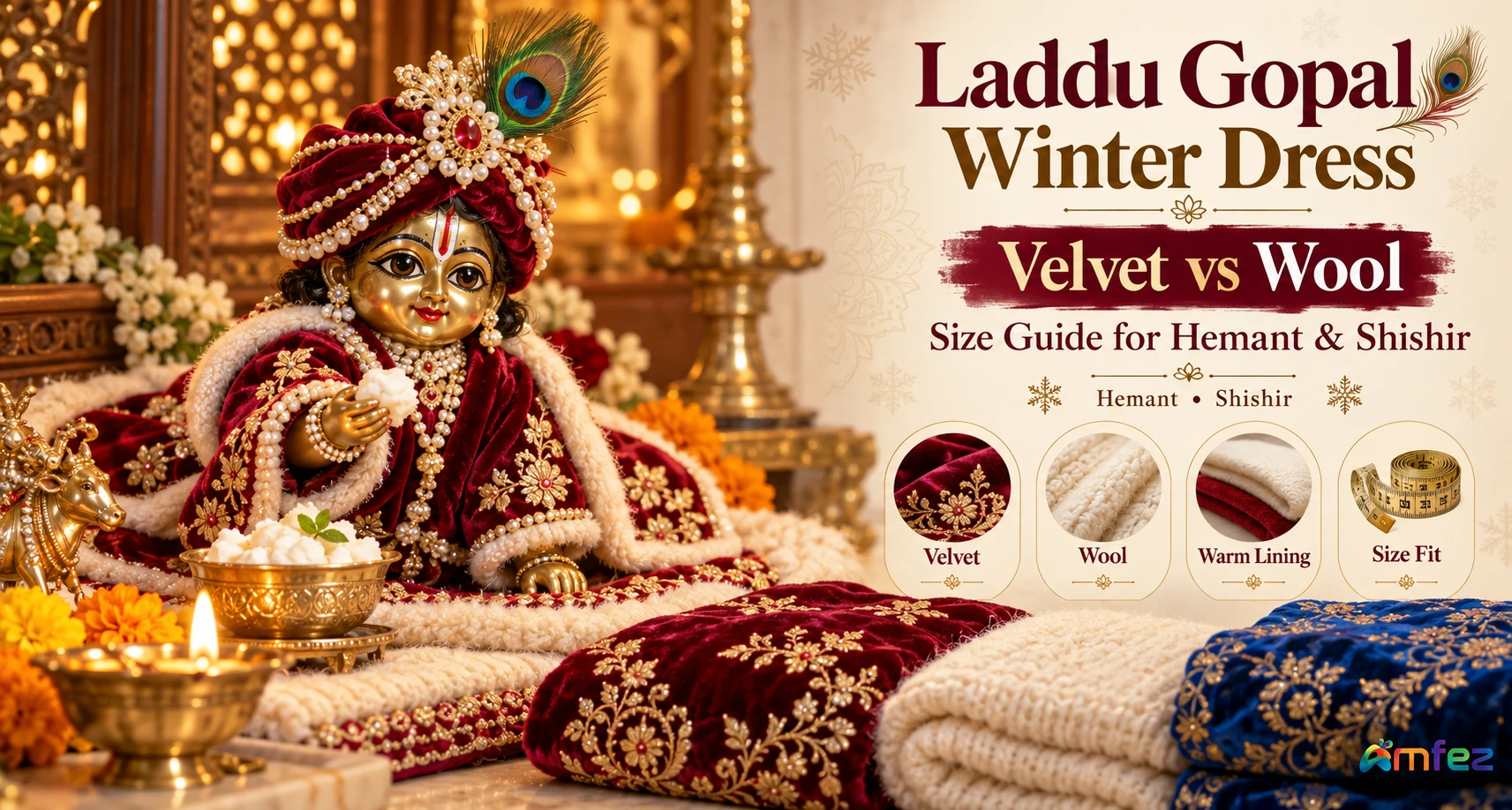
October hits, the nights cool down, and one thought quietly surfaces in every Laddu Gopal devotee's mind: "Thakur Ji ko thand lag rahi hogi." This is not superstition — it is the logic of seva. You feel the cold, so does He. In the Pushti Marg tradition, Laddu Gopal's poshak changes with the season, and winter is when the most care goes into choosing the right fabric.
Laddu Gopal winter dress is not just about aesthetics. It is about the right material — warm enough for Hemant and Shishir seasons, soft enough for a murti that size, and in colours that suit the winter darshan. This guide covers every fabric, every size, and the full winter shringar routine for Thakur Ji.
For Laddu Gopal's winter dress (October–February), the best fabrics are velvet, wool, and brocade silk. Velvet is the most popular — it is warm, regal-looking, and easy to dress a small murti in. Use dark colours (maroon, deep blue, forest green, purple). In extreme cold (December–January), add a small Rui (cotton) rjai or shawl. Change the poshak daily even in winter.
Why Does Laddu Gopal Need a Different Poshak in Winter?
In the Vaishnav seva tradition, Laddu Gopal is not a stone idol sitting on a shelf. He is a living child — a child who experiences heat, cold, hunger, and play. The Pushti Marg sampraday (founded by Shri Vallabhacharya) formalised this understanding into the Ashta Yama Seva — eight-time daily worship — with specific poshaks for each darshan and each season.
The logic is simple: if you cover yourself in a shawl in October, Thakur Ji also wears a warm poshak. If you light a heater in December, Thakur Ji also gets an extra layer. This is not literalism — it is bhav (devotional feeling), and bhav is the foundation of seva.
Practically, winter means the Hemant season (mid-October to mid-December) and Shishir season (mid-December to mid-February). The cold in North India during these months is real, and many devotees follow a niyam (vow) of not removing Thakur Ji's warm poshak until Basant Panchami in February.
Which Fabric is Best for Laddu Gopal Winter Dress — Velvet, Wool, or Silk?
| Fabric | Warmth | Look | Best For | Care |
|---|---|---|---|---|
| Velvet | ⭐⭐⭐⭐ | Rich, royal, festive | Oct–Jan; all festive occasions | Dry clean or gentle hand wash only |
| Wool / Woolblend | ⭐⭐⭐⭐⭐ | Cosy, traditional | Dec–Feb extreme cold | Gentle wash, air dry flat |
| Brocade Silk | ⭐⭐⭐ | Ornate, Kartik/Diwali special | Kartik Maas, Diwali, festive days | Hand wash cold, gentle |
| Cotton (lined) | ⭐⭐ | Simple, daily | October only; transition season | Machine washable |
| Rui (cotton quilt) | ⭐⭐⭐⭐⭐ | Added over poshak | Extreme winter nights — Dec/Jan | Keep dry; air out regularly |
Recommendation: Keep 2 velvet poshaks for October–January rotation, plus one wool poshak for December–January nights. Browse the full range in the Laddu Gopal poshak collection — velvet and woolen options available from ₹249.
Which Colours Work for Laddu Gopal Winter Poshak?
Winter darshan is traditionally in deeper, richer tones. Here is a seasonal colour guide:
- Yellow — Kartik's special colour
- Saffron — traditional Vaishnav tone
- White — purity, Devuthani Ekadashi
- Red/crimson — Diwali special
- Gold embroidered on any base
- Maroon — classic winter velvet
- Deep blue / navy — royal look
- Forest green — winter evergreen
- Purple — rich and warm-toned
- Burgundy — festive and warm
How to Choose the Right Size Laddu Gopal Poshak for Your Murti?
Laddu Gopal murtis come in specific sizes measured in inches — the standard is the height of the murti from the base to the top of the head. Poshaks are made to match these sizes. Buying the wrong size means the poshak either falls off or is too tight to dress properly.
| Murti Size | Height | Typical Household | Notes |
|---|---|---|---|
| 0 Number | ~1 inch | Very small travel murti | Rare; often no poshak used |
| 1 Number | ~2 inches | Common small home murti | Most popular size |
| 2 Number | ~3 inches | Medium home mandir | Most versatile size |
| 3 Number | ~4 inches | Larger home mandir | Poshak more elaborate at this size |
| 4 Number | ~5 inches | Large mandir or temple home | Full Solah Shringar items available |
| 5 Number | ~6 inches | Temple / large puja room | Full accessories available |
When in doubt, measure your murti from the base to the top of the head in centimetres and check the size guide on the product page. Most Amfez poshaks are designed for 1 to 4 Number murtis — the most common sizes in Indian homes.
लड्डू गोपाल की सर्दियों की पोशाक — क्या पहनाएँ, कौन सा कपड़ा चुनें?
अक्टूबर से फरवरी तक ठाकुर जी को गर्म कपड़ों की ज़रूरत होती है। वेलवेट (मखमल) सबसे अच्छा कपड़ा है — गर्म भी है, देखने में भी शाही लगता है। दिसंबर-जनवरी की कड़ी ठंड में ऊनी पोशाक या छोटी रजाई भी पहनाएँ। रंग के लिए — कार्तिक मास में पीला, और सर्दियों में मरून, गहरा नीला, और बैंगनी सबसे सुंदर लगते हैं।
Amfez पर लड्डू गोपाल की सर्दी वाली वेलवेट पोशाक ₹249 से उपलब्ध है — हर साइज़ में, हर रंग में। अभी देखें और ठाकुर जी को ठंड से बचाएँ।
Frequently Asked Questions — Laddu Gopal Winter Dress
Q: When should I switch Laddu Gopal to a winter dress?
A: Switch to a winter poshak when the night temperature in your city drops below 20°C — typically from mid-October in North India. In the festival calendar, the switch happens around Navratri (October) and is firmly in place by Diwali (20 October 2026). Keep the winter poshak on until Basant Panchami (January 29, 2027), when you switch back to spring fabrics.
Q: Is velvet or wool better for Laddu Gopal in winter?
A: Both are excellent, but for different purposes. Velvet is the best all-rounder — it looks festive, provides good warmth, and is easier to find in the right size. Wool provides more warmth in extreme cold (December–January nights in Delhi/UP/Rajasthan) but can feel stiff on a small murti. Most devotees use velvet for daily wear and add a small wool shawl or cotton rjai during peak winter.
Q: Can I wash Laddu Gopal's velvet poshak at home?
A: Yes — very gently. Hand wash in cold water with a mild detergent. Do not scrub or wring. Gently squeeze out water and lay flat to dry in shade — never tumble dry and never iron a velvet poshak directly (it crushes the pile). If the poshak has heavy zari work or stonework, dry cleaning is safer. Always dry completely before wearing on the murti to avoid moisture damage.
Q: Does Laddu Gopal really need a different poshak for winter or is it just tradition?
A: In devotional practice, the change of seasonal poshak is both tradition and bhav (feeling). The tradition codifies the bhav: when you lovingly change Thakur Ji's poshak with the season, you are actively thinking about His comfort and care — which is the point of seva. Whether or not the murti physically feels cold is beside the point; the devotee who feels it on His behalf is doing exactly what seva is meant to do.
Q: लड्डू गोपाल की पोशाक कितने दिन में बदलनी चाहिए?
A: रोज़ बदलना सबसे उत्तम है। दैनिक सेवा में सुबह नई पोशाक पहनाएँ और रात को शयन पोशाक (हल्का, आरामदायक कपड़ा) पहनाएँ। अगर रोज़ नहीं हो सकता, तो कम से कम हर 2–3 दिन में एक बार बदलें। त्योहार और एकादशी के दिन विशेष पोशाक पहनाएँ।
Q: लड्डू गोपाल के लिए सबसे अच्छी सर्दियों की पोशाक कहाँ मिलेगी?
A: Amfez.com पर लड्डू गोपाल की वेलवेट और ऊनी पोशाक 1 नंबर से 5 नंबर तक सभी साइज़ में उपलब्ध है। मरून, गहरा नीला, पीला, और बैंगनी सर्दियों के स्पेशल रंग हैं। ₹249 से शुरुआत, घर पर डिलीवरी।