


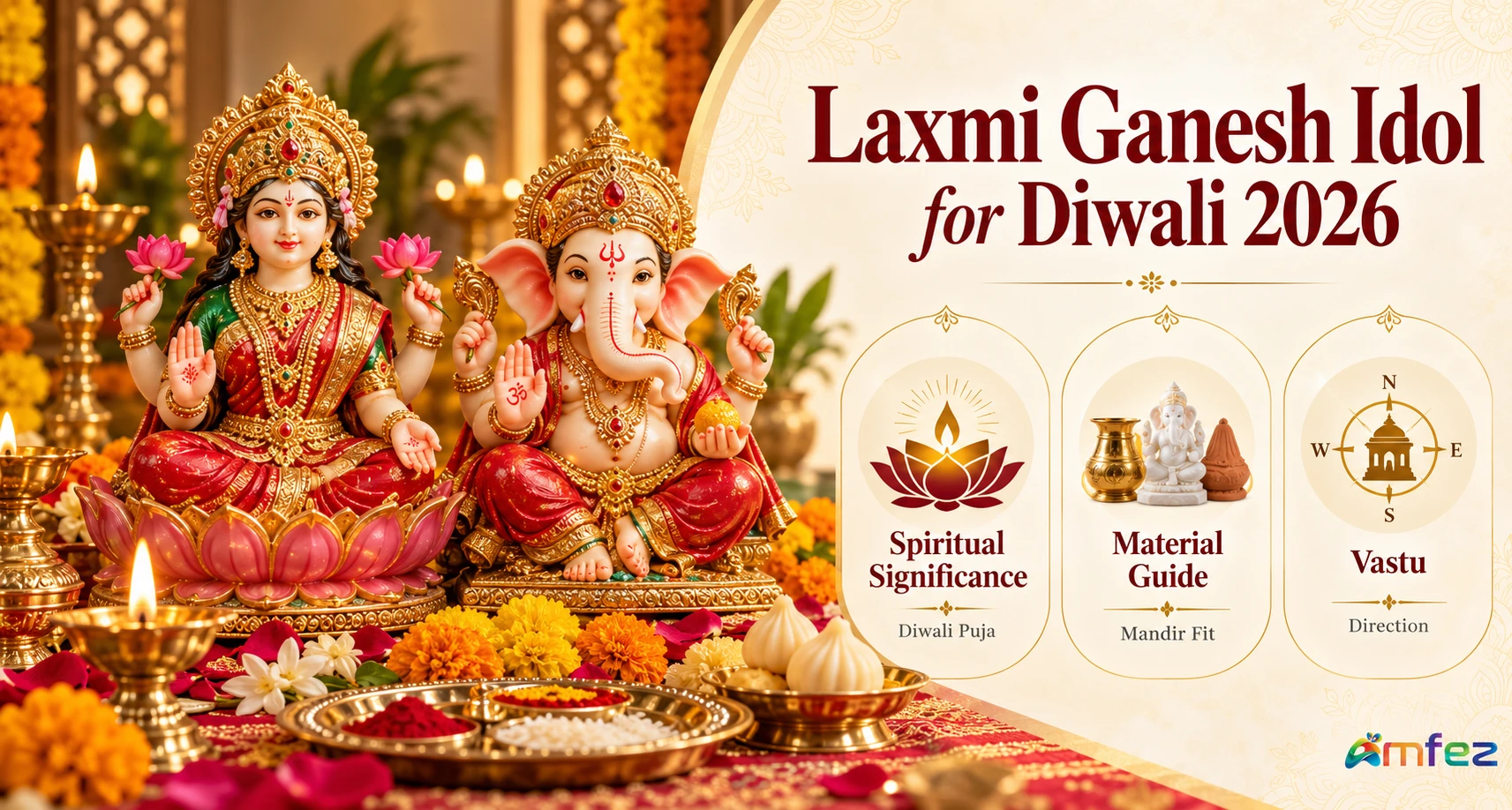
On the night of Diwali, when the first diya is lit and the scent of marigold fills the air, there is one image that sits at the centre of every Hindu home — Maa Lakshmi, radiant in gold, seated beside Ganesh Ji. This pairing is not an accident. It is one of the most theologically precise traditions in Sanatan Dharma, rooted in thousands of years of Vedic and Puranic wisdom.
This guide explains the spiritual significance of the Laxmi Ganesh idol for Diwali, what to look for when choosing one, and how to install it correctly so the puja is complete. Diwali 2026 falls on 20 October 2026 — plan your idol purchase now so you have time for proper pratishtha (installation).
For home Diwali puja, a terracotta or clay Laxmi Ganesh idol is traditionally preferred — these are biodegradable and considered most sacred for festival use. Brass or Panchdhatu (5-metal alloy) idols are ideal if you want one that stays in the mandir all year. Keep the idol between 6 and 12 inches in height for a home mandir. East or north-facing is the correct direction for Lakshmi.
Why Are Laxmi and Ganesh Worshipped Together on Diwali?
This question has a beautiful answer rooted in both scripture and folklore. In the Puranas, Maa Lakshmi is the goddess of wealth, prosperity, and divine fortune. Ganesh Ji is Vighnaharta — the remover of obstacles, and the first deity to be invoked before any auspicious act.
The pairing on Diwali follows a specific Vedic logic: wealth (Lakshmi) can only be received and held by one who has first removed all obstacles from their path (Ganesh). One without the other is incomplete. According to the Lakshmi Stotra from the Padma Purana, Maa Lakshmi herself requested that Ganesh be worshipped alongside her so that the wealth she bestows is not wasted or taken away by misfortune.
There is also a folk belief across Maharashtra, Gujarat, and Rajasthan: Lakshmi Ji does not enter a home where Ganesh is not seated at the door. The clay idol placed at the threshold on Diwali is therefore both an invitation and a protection.
What Are the Different Forms of Laxmi Worshipped on Diwali?
Most people think of Mahalakshmi as one goddess. In the Vedic tradition, she has eight distinct forms — the Ashtalakshmi — each blessing a different kind of abundance:
| Form | Blesses | Diwali Significance |
|---|---|---|
| Adi Lakshmi | Primordial fortune | The root form — most commonly worshipped on Diwali night |
| Dhana Lakshmi | Financial wealth | Worshipped by traders and businesspeople on Diwali |
| Dhanya Lakshmi | Food and grain abundance | Worshipped in the kitchen — new grain offered as bhog |
| Gaja Lakshmi | Power and sovereignty | Two elephants flanking Lakshmi — the "Gaja Lakshmi" idol form |
| Santana Lakshmi | Children and family | Worshipped for family well-being and progeny |
The most commonly sold Laxmi Ganesh idol for Diwali shows Lakshmi seated, with coins flowing from her right hand (representing Dhana Lakshmi), flanked by two lotuses. Ganesh sits to her right — the position of honour in Hindu tradition.
Which Material is Best for Laxmi Ganesh Idol for Diwali?
| Material | Best For | Vastu | After Diwali |
|---|---|---|---|
| Clay / Terracotta | Traditional Diwali puja | ✅ Highly auspicious | Visarjan (immersion) or plant in garden |
| Brass / Panchdhatu | Permanent home mandir | ✅ Best for year-round puja | Stays in mandir permanently |
| Marble / White Stone | Premium home mandir | ✅ Sattvic — calming energy | Permanent — treated with high reverence |
| Resin / Polyresin | Gifting, decoration | ⚠️ Fine for decoration; not ideal for main puja | Can be kept as home decor |
| Silver | Highly auspicious Diwali gift | ✅ Silver = Chandra (moon) — Lakshmi's favourite metal | Store in velvet box, worship on each Purnima |
For Diwali 2026 puja, the most traditional choice remains the clay or terracotta idol, purchased fresh each year. After the puja, this idol is either immersed in a water body or placed under a peepal or tulsi plant. If you prefer one idol that serves both the festival puja and the home mandir all year, a brass or panchdhatu idol is the most practical and Vastu-correct choice.
Browse the complete God idol collection at Amfez, including a range of Laxmi Ganesh murtis in multiple materials and sizes.
Where Should the Laxmi Ganesh Idol Face on Diwali?
According to Vastu Shastra, Maa Lakshmi should face east or north. This means:
- Place the idol on the east or north wall of your puja room — so the murti faces east (towards the sunrise) or north (towards Kubera, the lord of wealth)
- Ganesh Ji should be to Lakshmi's right from the deity's perspective (which is the viewer's left)
- The idol should be at eye level when seated — never on the floor
- Never place the idol directly against the wall — leave a small gap of at least one inch
- The idol should face you when you sit for puja, not face the wall
Also see our detailed Vastu guide for home mandir idols — the same direction principles apply for Laxmi Ji as they do for Durga Ji.
दिवाली पर लक्ष्मी गणेश मूर्ति — क्या खरीदें?
दिवाली 2026 (20 अक्टूबर) के लिए लक्ष्मी गणेश की मूर्ति मिट्टी की हो तो सबसे उत्तम है — यह परंपरागत और शास्त्रसम्मत है। अगर घर के मंदिर में स्थायी रूप से रखनी हो, तो पीतल या पंचधातु की मूर्ति लें। मूर्ति की ऊंचाई 6 से 12 इंच के बीच हो। लक्ष्मी जी का मुख पूर्व या उत्तर दिशा में होना चाहिए। गणेश जी को लक्ष्मी जी के दाईं ओर रखें।
दिवाली से एक दिन पहले (नरक चतुर्दशी / छोटी दिवाली) मूर्ति को साफ करें और अपने स्थान पर रखें। फिर दिवाली की रात प्रदोष काल (सूर्यास्त के बाद) में पूजा करें।
Frequently Asked Questions — Laxmi Ganesh Idol for Diwali
Q: Can we buy a new Laxmi Ganesh idol every year for Diwali?
A: Yes — and in many traditions, buying a new clay or terracotta Laxmi Ganesh idol each Diwali is considered auspicious. It symbolises welcoming Maa Lakshmi afresh into the home. The old clay idol is respectfully immersed after the festival. For brass or metal idols in the permanent home mandir, the same idol is worshipped year after year; only the poshak, flowers, and bhog change.
Q: Why is Ganesh Ji placed to Laxmi Ji's right on the Diwali idol?
A: In Hindu puja tradition, the right side is the position of honour. Ganesh Ji, as the first among all deities to be invoked (Pratham Puja), receives this place of honour beside Maa Lakshmi. The Skanda Purana records that Ganesh is Lakshmi's "door guardian" — no wealth enters a home where the path is not first cleared by Ganesh.
Q: Is a silver Laxmi Ganesh idol better than a brass one?
A: Both are excellent. Silver is considered especially auspicious for Lakshmi because silver is associated with the moon (Chandra), and Lakshmi is a goddess of divine light. However, brass (Panchdhatu) is the most practical for daily puja — it is durable, does not tarnish as quickly, and is considered just as sacred in the Agama Shastra tradition. Choose based on your budget and how often you will do daily abhishek (ritual bathing).
Q: What size Laxmi Ganesh idol is right for a home mandir?
A: For a home mandir, 6 to 12 inches is the ideal range. An idol smaller than 6 inches can feel diminutive and may be difficult to do a full shringar. An idol larger than 12 inches requires dedicated temple space with at least 18 inches of clearance above and around it. For a shelf or small mandir niche, 6–8 inches is perfect; for a dedicated puja room, 10–12 inches.