


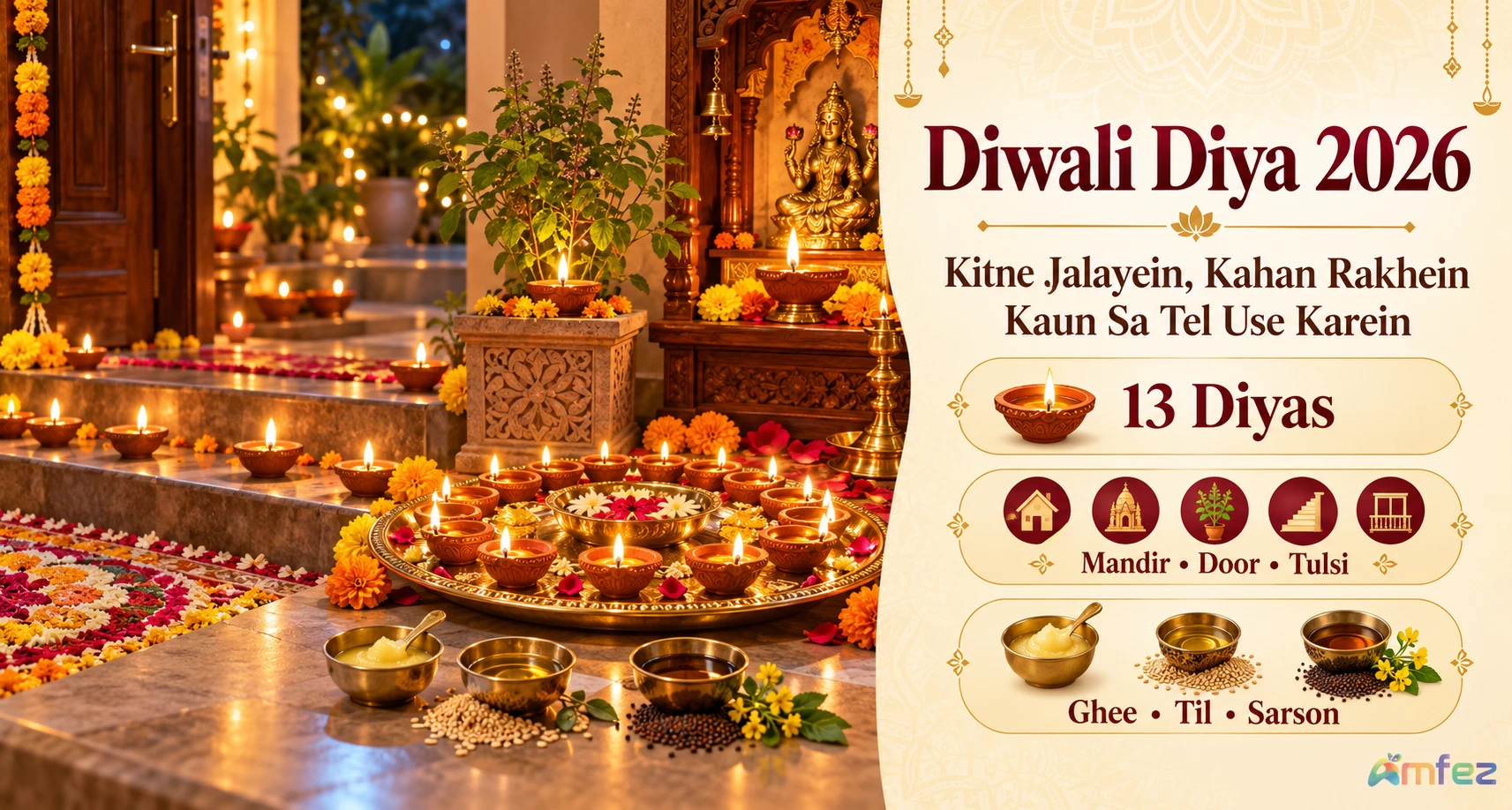
A single clay diya, lit with ghee and a cotton wick, placed at the threshold of a home on Diwali night — this image is perhaps the most iconic in all of Hindu festival tradition. The diya is not merely decoration. It is a living prayer.
The word diya (or deepa) comes from the Sanskrit root dip, meaning to shine or illuminate. The Rigveda, one of the world's oldest texts, speaks of deepa as a symbol of Agni — divine fire — that destroys darkness and invites divine presence. When you light a diya on Diwali, you are continuing a ritual that has been performed without interruption for at least 2,500 years.
This guide covers everything about Diwali diya — why we light them, how many to light, which oil or ghee to use, and how to arrange them for maximum spiritual and visual impact. Diwali 2026 falls on 20 October 2026.
Light diyas with pure cow ghee or sesame oil (til ka tel) — these are most auspicious according to Dharmashastras. Cotton (white) wicks only. Minimum 13 diyas in most North Indian traditions; some traditions light 26 or 108. Diyas go at the main door, every room corner, tulsi plant, stairs, and near the mandir. Light at Pradosh Kaal — 6:15 PM to 8:30 PM on 20 Oct 2026.
Why Do We Light Diyas on Diwali?
The story of Diwali's diyas is the story of light returning to the world. According to the Valmiki Ramayana, when Lord Ram returned to Ayodhya after 14 years of vanvas and defeating Ravana, the people of Ayodhya lit rows of diyas to welcome him home. It was a new moon night (Amavasya) — completely dark. The rows of diyas transformed the darkness into a blazing city of light. This is why Diwali is also called Deepawali — the row of lights (deepen + avali).
There is a second and equally important tradition: on Diwali night, Maa Lakshmi herself is said to roam the earth, blessing the homes that are brightest. The Lakshmi Purana states: "Grihe yatra deepo jvalati, tatra Lakshmih prativasati" — where a lamp burns in the home, there Lakshmi dwells. This is why no corner of the house is left dark on Diwali.
According to historical records, the tradition of lighting diyas on Diwali is documented in texts as far back as the 9th century CE, making it one of the world's most sustained unbroken ritual traditions.
How Many Diyas to Light on Diwali?
| Tradition | Number of Diyas | Where |
|---|---|---|
| North Indian (common) | 13 diyas minimum | 5 at main door, 4 corners of home, 1 tulsi, 1 mandir, 1 bathroom/toilet (yes — to light all corners), 1 roof |
| Gujarat tradition | 26 diyas | Every door, window sill, step, tulsi, and inside each room |
| Vaishnavite tradition | 108 diyas | Around tulsi plant in 108 continuous circles — a form of deep-puja called Deep Mahotsav |
| Temple tradition | 1001 or more | Maha-deepa mahotsav — entire temple lit, often carried in procession |
For a modern home, 13 is the sacred minimum. But even one diya lit with sincere intention outweighs 1000 lit carelessly. The Bhagavad Gita reminds us that the quality of the offering matters far more than the quantity.
Which Oil or Ghee to Use in Diwali Diya?
This question has a clear scriptural answer. The Garuda Purana and the Skanda Purana both specify different oils for different intentions:
- Pure cow ghee (desi ghee) — Most auspicious of all. Cow ghee purifies the environment when burnt. Used in havan and the main puja diya. Lakshmi Ji's preferred diya offering
- Sesame oil (til ka tel) — Used specifically for ancestor puja (Pitra Tarpan). On Diwali night, one sesame oil diya is lit facing south to honour the ancestors
- Mustard oil (sarson ka tel) — Most widely used in North India for Diwali diyas outside the main puja — on steps, windows, and boundary walls. More economical for large numbers
- Castor oil (arandi ka tel) — Used in some South Indian traditions for Narak Chaturdashi (Choti Diwali, 19 Oct 2026)
Never use petroleum-based or synthetic oils in puja diyas — these are not considered sacred and can be harmful to breathe in an enclosed puja space.
Clay Diya vs Decorative Diya — Which Should You Buy?
Both have their place in a Diwali setup, and the two are not in competition. Here is how to think about it:
Clay diyas (mitti ke diye): Made from earth — the most sattvic (pure) material. These are what you use for the main puja and for lighting near the mandir. The flame in a clay diya burns differently from metal — it is considered to be closer to a "natural" flame. Clay diyas absorb a small amount of oil continuously, keeping the flame steady even in a light breeze. Buy these fresh each year — old clay diyas that have been burnt before are not reused in traditional puja.
Decorative diyas: Metal, terracotta with colour work, glass, or ceramic diyas used for decoration — windowsills, stair edges, garden paths, the entrance. These are for the visual festival atmosphere. They can be reused each year.
Shop the Diwali diya collection — decorative diyas from ₹49, clay diya sets, and batti (wicks) for home puja available.
Where to Place Diyas on Diwali — Complete Placement Guide
- Main door (threshold) — 1 diya on each side of the door frame. This is the most important placement — Maa Lakshmi enters through the main door
- Tulsi plant — 1 or 3 diyas around the base of the tulsi. Tulsi is considered Lakshmi's favourite plant
- Home mandir — minimum 1 diya, kept burning through the night. Use ghee here
- Every room — 1 diya in the northeast corner (Ishaan kona) of each room
- Kitchen — 1 diya near the stove area and 1 in the northeast corner
- Steps and staircase — 1 on each step, lighting the path to the home
- Boundary walls / balcony edge — rows of clay diyas facing outward, inviting Lakshmi from all directions
- One facing south — the Pitra diya, lit in sesame oil for the ancestors
दिवाली पर दिया कितने जलाएं और कहाँ रखें?
दिवाली पर कम से कम 13 दिए जलाने चाहिए। मुख्य दरवाजे पर 2 (दोनों तरफ), तुलसी के पास 1-3, मंदिर में 1 (देसी घी से), हर कमरे के कोने में 1, रसोई में 1, सीढ़ियों पर, और छत पर। एक दिया दक्षिण दिशा में तिल के तेल से जलाएं — यह पितरों के लिए है। प्रदोष काल (20 अक्टूबर 2026 को सूर्यास्त के बाद — लगभग 6:15 से 8:30 बजे) में पूजा करें और दिए जलाएं।