


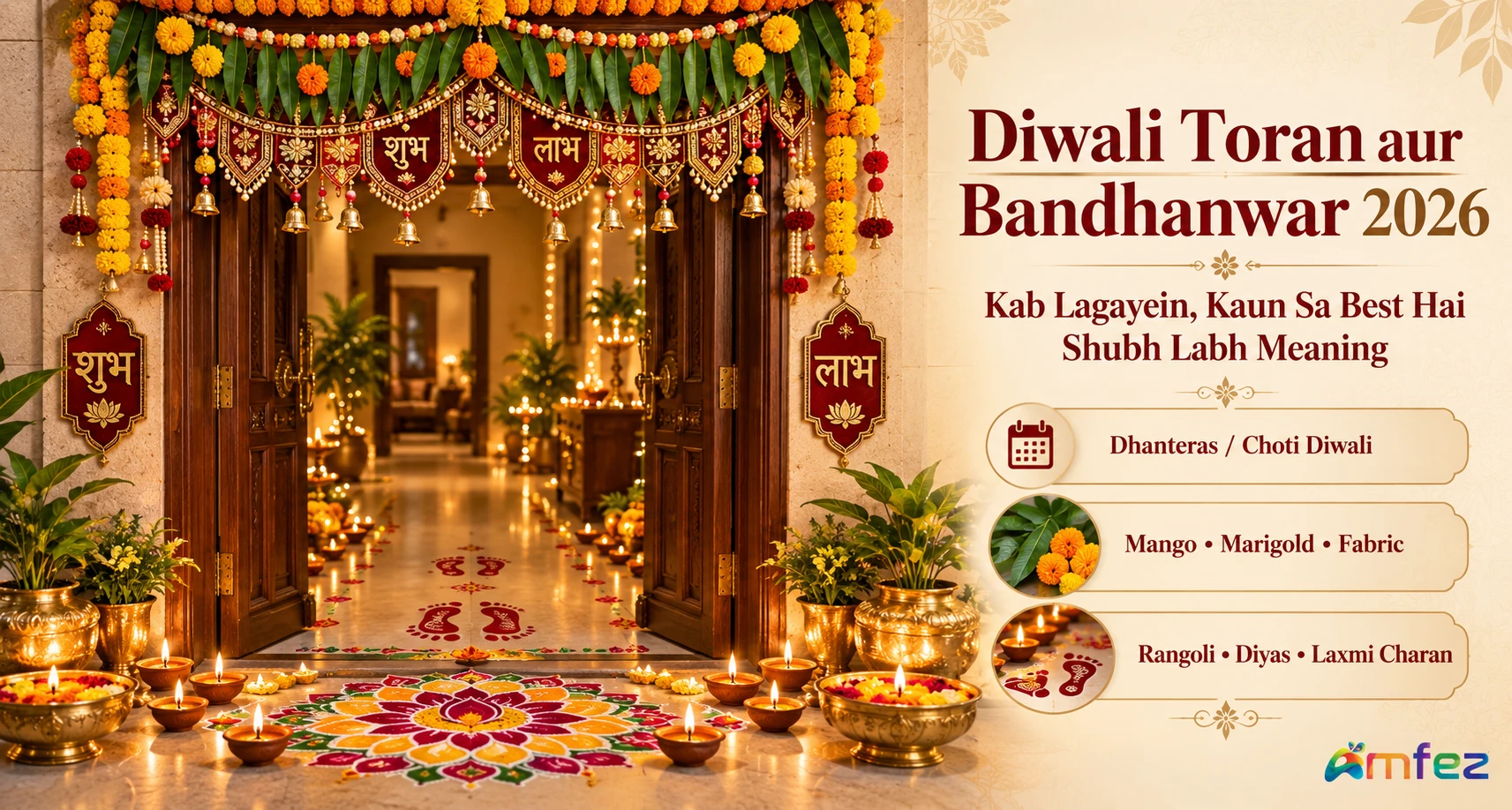
Before Maa Lakshmi enters a home on Diwali night, she pauses at the door. In the folk belief of North India, Gujarat, and Maharashtra, the Goddess first looks at the entrance — at whether the door is decorated, whether the toran is hung, whether flowers have been offered. The toran is not just décor. It is the first signal that you are ready to receive her.
This guide covers the complete Diwali toran and bandhanwar tradition — what each is, why it is hung, which materials are most auspicious, and how to set up your entrance for Diwali 2026 (20 October 2026). We also cover the wider world of Diwali entrance decoration so your home is truly ready.
A toran is a decorative garland hung horizontally above a door frame. A bandhanwar is a longer hanging that covers the entire door width and often includes a central motif plus side hangings — more elaborate than a toran. Both serve the same purpose: to mark the entrance as auspicious and invite divine presence. Both are hung before Diwali, traditionally on Dhanteras (18 Oct 2026) or Choti Diwali (19 Oct 2026).
What is a Toran and Why is it Hung on Diwali?
The toran is one of the most ancient elements of Indian home decoration. Archaeological evidence from the Sanchi Stupa (3rd century BCE) shows toran-shaped gateways as a distinctly Indian design element. The word toran comes from Sanskrit, meaning gateway or arch.
In Hindu tradition, a toran serves three purposes:
- It purifies the entrance — mango leaves (used in traditional torans) release oxygen and are considered to have antimicrobial properties. The Garuda Purana specifies mango leaf toran for all auspicious occasions
- It signals auspiciousness — a decorated door tells Maa Lakshmi that the home is prepared for her visit
- It wards off evil — the nazar battu (black lemon-chilli), often combined with the toran, keeps negative energy from entering through the main door
The toran (torana) appears in Buddhist, Jain, and Hindu traditions across the subcontinent — marking gates, temples, and homes in all three faiths as a pan-Indian symbol of welcome and blessing.
Which Toran is Most Auspicious for Diwali?
| Toran Type | Material | Auspiciousness | Lasts |
|---|---|---|---|
| Mango Leaf Toran | Fresh mango leaves threaded together | ⭐⭐⭐⭐⭐ — Highest. Scripturally prescribed | 4–5 days fresh |
| Marigold Toran | Fresh marigold flowers strung | ⭐⭐⭐⭐⭐ — Highly auspicious (Lakshmi's favourite flower) | 2–3 days fresh |
| Fabric / Cloth Toran | Embroidered or printed cloth with tassels | ⭐⭐⭐⭐ — Excellent, reusable | Years — reuse every Diwali |
| Beaded / Metal Toran | Metal coins, beads, and shells | ⭐⭐⭐ — Decorative, permanent | Many years |
| Shubh Labh Bandhanwar | Printed or embossed with Shubh-Labh | ⭐⭐⭐⭐ — Traditional Diwali entrance symbol | Reusable |
The most traditional Diwali entrance uses both: a mango leaf or marigold toran above the door AND a cloth bandhanwar below it. The two layers create a complete entrance that is both visually rich and spiritually complete.
What is Shubh Labh and Why is it on Every Diwali Door?
If you have ever seen the two Sanskrit words written on either side of a doorway during Diwali — Shubh on the right, Labh on the left — these are not just decorative. They are an invocation.
Shubh (शुभ) means auspicious — good, blessed, positive. Labh (लाभ) means gain, profit, or benefit. Together, they form a wish at the threshold: "May only auspicious gain enter through this door."
In North Indian Diwali tradition, these words are written by children as a blessing — because children's words are considered pure. They are also placed as stickers or embossed on bandhanwars. In business communities (especially Marwari and Gujarati), Shubh Labh is painted at the entrance of shops, on new account books (Chopda Puja), and on safes and cash boxes on Diwali night.
How to Hang Toran Correctly for Diwali
- Height — Hang the toran at or just above the top of the door frame, at eye level or slightly above when standing outside
- Direction — The toran faces outward — towards the street, not into the home. This means it is welcoming energy in from outside
- When to hang — On Dhanteras (18 Oct 2026) or Choti Diwali (19 Oct 2026). Never on Diwali morning — the entrance should be ready before sunrise of Diwali day
- With what — Rangoli at the entrance, laxmi charan stickers (footprints) leading from the door inward, and one diya on each side of the door frame
- How long to keep — The fresh toran (mango/marigold) is removed after 5 days. A cloth or metal toran stays through the full Diwali period (until Bhai Dooj, 22 Oct 2026)
Shop the complete range of Diwali toran and bandhanwar at Amfez. Also see the Navratri decoration guide for mandir decoration ideas that complement your Diwali entrance setup.
Diwali Entrance Decoration — Complete Setup Guide for 2026
| Element | Where | When to Place |
|---|---|---|
| Toran / Bandhanwar | Above main door | Dhanteras (18 Oct) |
| Rangoli | Doorstep, centre | Diwali morning (20 Oct) |
| Laxmi Charan Sticker | Floor, leading into home | Diwali morning |
| Shubh Labh at door sides | Right side Shubh, Left side Labh | Diwali morning |
| Clay diyas | Both sides of door frame | Light at Pradosh Kaal (6:15 PM, 20 Oct) |
| Marigold garland | Around door frame | Diwali morning (fresh) |
दिवाली पर तोरण कब और कैसे लगाएं?
दिवाली 2026 (20 अक्टूबर) से पहले धनतेरस (18 अक्टूबर) या छोटी दिवाली (19 अक्टूबर) को तोरण लगाएं। मुख्य दरवाजे के ऊपर आम के पत्तों या गेंदे के फूलों का तोरण सबसे शुभ होता है — यह शास्त्रसम्मत भी है। कपड़े या धातु का बंधनवार भी लगा सकते हैं जो हर साल प्रयोग होता है। दरवाजे के दाईं ओर "शुभ" और बाईं ओर "लाभ" लिखें। प्रवेश द्वार पर रंगोली बनाएं और लक्ष्मी चरण चिपकाएं।